Scan report before your appointment: how to read it
What Radily gives back
Your chest CT report says
Scattered ground-glass opacities are noted in the bilateral upper lobes measuring up to 8mm. No consolidation, pleural effusion, or pneumothorax.
Radily explains
Your scan shows some small hazy areas in the upper part of both lungs. There is no solid patch of the kind pneumonia makes, no fluid around the lungs and no collapsed lung.
Ask your doctor: what might be causing the hazy areas, and do I need a follow-up scan?
$4.99 per report · ready in about 10 minutes · encrypted, then deleted
It happens more and more: the report from your MRI, CT, ultrasound or X-ray turns up in an app, a patient portal or the post, and the appointment to talk about it is days or weeks away. Around Christmas and New Year the gap is often longer, because clinics run fewer sessions.
This guide shows you how a report is laid out and how to read it calmly. It explains the wording. It cannot tell you what your own result means for you, and neither can any website: that is the job of the doctor or team that ordered the scan.
Who the report was written for
A radiology report is a letter from one specialist to another. A radiologist looks at the pictures and writes to the doctor who asked for the scan. It is written in shorthand, for a reader who already knows your symptoms, your examination and your other tests.
That is why it can read as cold or alarming. It lists everything the radiologist saw, including things that have nothing to do with why you were scanned, and it uses cautious phrases that have a set meaning between doctors.
In the UK, the NHS App warns that you "may see test results in your record that your healthcare professional has not yet discussed with you", and says to contact your GP if you have concerns. In the US, reports often reach a patient portal before the doctor's office has rung you. Seeing the report first is now normal. It does not mean anyone has forgotten you.
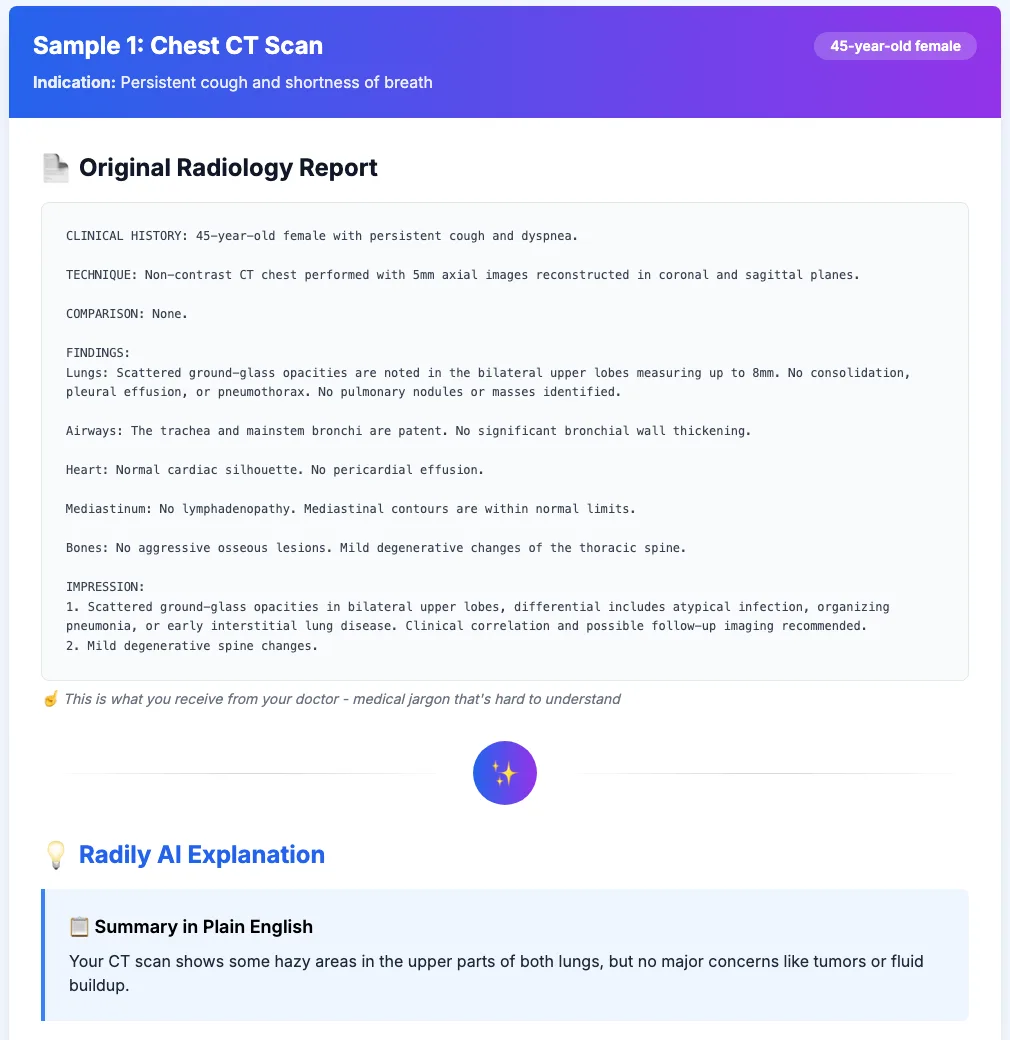
A sample report on Radily's examples page, with the plain-English summary underneath. See the full examples.
How a report is laid out
Most reports have the same parts, though the headings vary between hospitals.
- Clinical history or indication. Why the scan was asked for, in a line or two.
- Technique. How the scan was done: which body part, and whether contrast dye was used.
- Comparison. Any earlier scans the radiologist looked at alongside this one. See no prior studies for comparison.
- Findings. A tour of everything in the pictures, organ by organ, normal and not.
- Impression or conclusion. The radiologist's summary for your doctor. See the Impression.
Read it in this order
- Start at the end. The impression or conclusion is the summary. The findings section is the working-out.
- Look for a recommendation. Phrases such as "follow-up imaging recommended" or recommend further evaluation mean the radiologist is suggesting a next step to your doctor. Make a note of it so you can ask about it.
- Then read the findings. Expect a long list. Radiologists describe what they see whether or not it matters to your symptoms.
- Mark every word you do not understand. Look up the term itself, not the term plus a disease name.
- Write your questions down. Take the list to the appointment. Our guide to questions to ask at your follow-up appointment has a ready-made set.
Have a sentence you cannot make sense of? Paste it into the free box on the report phrases page. It picks out the terms it recognises and shows what each one means, with no sign-up and nothing to pay. For the whole report explained section by section, you can paste the text into Radily for $4.99.
Report words that are often misread
These are words about how sure the radiologist is, or how they are describing something. They are not verdicts.
- Unremarkable is the radiologist's word for "nothing unusual seen here". It is not a comment on you.
- Incidental finding means something noticed that was not what the scan was looking for.
- Nonspecific means the appearance has more than one possible explanation and the picture alone does not say which.
- Cannot be excluded means the scan could not rule something out. It does not say that thing is present.
- Clinical correlation is recommended asks your doctor to weigh the picture against your symptoms and other tests.
- Consistent with means the appearance fits a particular explanation.
- Stable means no change from an earlier scan.
- Limited study means something, such as movement, made the pictures harder to read.
What any of these means in your case depends on the rest of the report and on you. That is the conversation to have at your appointment.
What a report cannot tell you
- How you are. A scan is a set of pictures taken on one day. Your doctor reads it together with your symptoms, an examination and other results.
- What happens next. The report may suggest a next step, but the doctor who ordered the scan decides.
- How worried to be. Neither the length of a report nor the number of unfamiliar words is a guide. A long report may simply describe many structures one by one, and a short one can still need a conversation.
Things to avoid while you wait
- Searching a single word next to the name of an illness. You will find the worst case, not your case.
- Reading meaning into silence. Results reach the referring doctor first, and clinics are slower over holidays. See how long scan results take over Christmas and New Year.
- Changing or stopping any medicine because of something in the report.
Who to contact
If you have questions, or the wait is hard, you do not have to sit on it until the appointment.
In the UK:
- Contact your GP surgery, or the hospital team that ordered the scan. Their number is usually on your appointment letter.
- If you think you need medical help now and cannot reach your GP, use NHS 111 (online at 111.nhs.uk, in the NHS App, or by phone).
- Call 999 or go to A&E in an emergency.
In the US and elsewhere: message or ring the office of the doctor who ordered the scan. Call your local emergency number (911 in the US) in an emergency.
If your symptoms are new, getting worse or frightening you, get help the same day. Do not wait for the appointment, whatever the report says.
A calmer way to use the wait
Understanding the words is a good use of the days before an appointment. You arrive knowing what the report says, with your questions written down, and you can spend the time with your doctor on what it means for you. The glossary and the report phrases pages cover the terms one at a time, and the FAQ explains what Radily can and cannot tell you.
This guide explains how radiology reports are laid out and how their wording is commonly used. It is general information, not a diagnosis and not medical advice. Only your doctor or the team that ordered your scan can tell you what your own report means for you. The UK contact details are from NHS.uk, checked on 19 November 2026.
Need Help with Your Own Report?
Get a personalized AI explanation of YOUR medical imaging report in just 10 minutes.
Upload Your Report NowAbout the Author
Radily Team - Written by the Radily team of medical professionals and AI specialists dedicated to making medical imaging accessible to everyone.
Related Articles
Questions to ask at your follow-up after a scan
A list of questions for the appointment after an MRI, CT, X-ray or ultrasound: what the report says, what it means for you and what happens next.
Scan results over Christmas and New Year: how long?
How long MRI, CT, X-ray and ultrasound results usually take according to the NHS, why Christmas and New Year can slow them down, and who to ring.
Understanding Your Medical Imaging Results: A Complete Patient Guide
Learn how to interpret your medical imaging results, what to ask your doctor, when to worry, and how to prepare for follow-up care after CT, MRI, or X-ray scans.