Questions to ask at your follow-up after a scan
What Radily gives back
Your chest CT report says
Scattered ground-glass opacities are noted in the bilateral upper lobes measuring up to 8mm. No consolidation, pleural effusion, or pneumothorax.
Radily explains
Your scan shows some small hazy areas in the upper part of both lungs. There is no solid patch of the kind pneumonia makes, no fluid around the lungs and no collapsed lung.
Ask your doctor: what might be causing the hazy areas, and do I need a follow-up scan?
$4.99 per report · ready in about 10 minutes · encrypted, then deleted
Follow-up appointments are short, and it is easy to walk out and remember the question you meant to ask. This is a list to pick from, grouped by what you are trying to find out. Nobody needs all of them. Choose the few that matter most to you, write them down and take them with you.
The list is general. It does not tell you what your result means, and it is not a substitute for the conversation. Its only job is to help you get more out of that conversation.
Before you go
NHS.uk's advice on what to ask your doctor is a good base for any appointment:
- Write down your 2 or 3 most important questions.
- List or bring all your medicines, including vitamins and supplements.
- Take a friend or family member if it helps. A second pair of ears is useful.
- If you do not understand a word, ask for it to be written down and explained.
- Afterwards, write down what was discussed and what happens next.
If you already have the report, read it once before you go and mark the words you do not know. Our guide to reading a scan report before your appointment shows which part to read first.
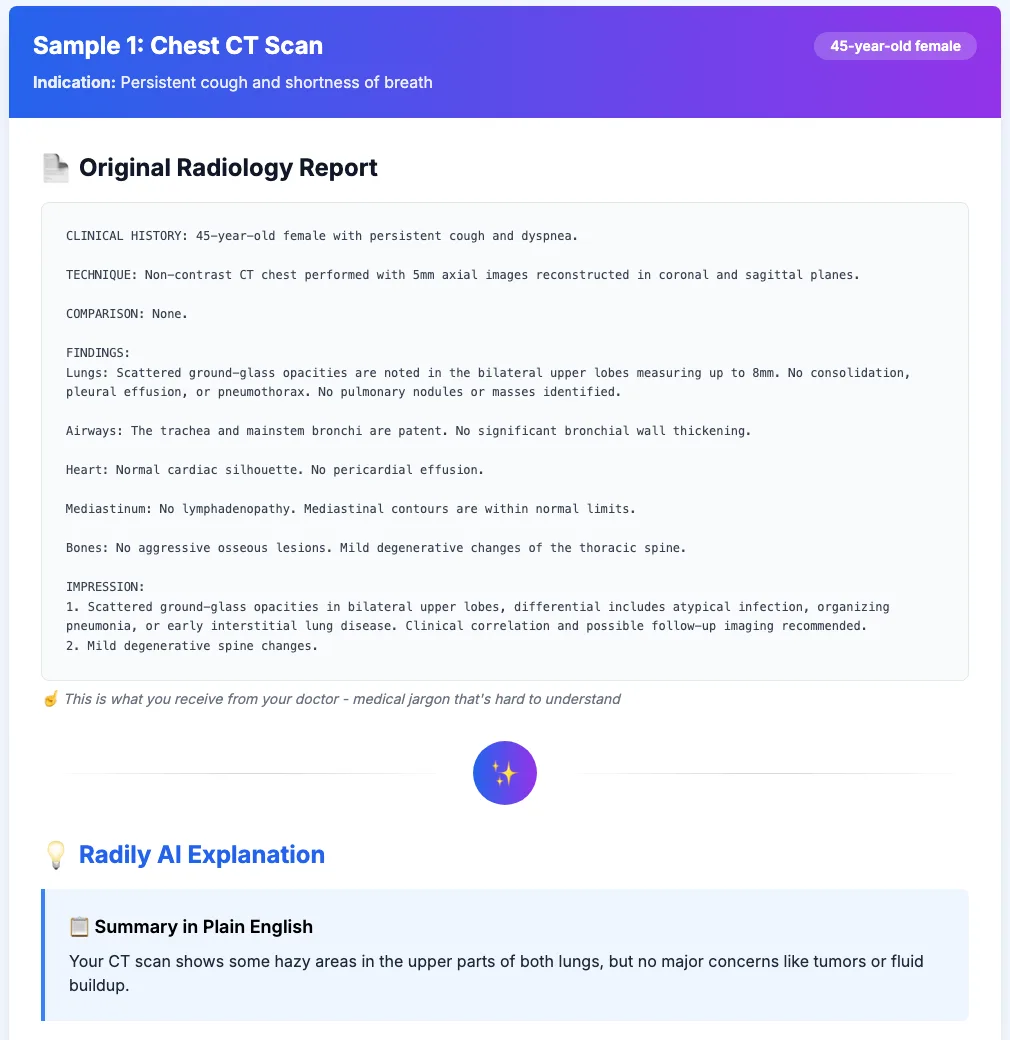
A sample report on Radily's examples page with its plain-English summary. See the full examples.
Questions about what the scan showed
- What was the scan looking for, and did it answer that question?
- What is the main finding, in plain words?
- Does the scan explain my symptoms, partly explain them, or not explain them?
- Is there anything in the report that was not what you were looking for? What does it mean for me? (Reports call this an incidental finding.)
- The report uses the word or phrase "…". What does that mean here?
- Was the scan compared with an earlier one? Has anything changed? (Look for words such as stable or no interval change.)
- Was there anything the scan could not show clearly? (Reports may say limited study.)
Questions about what it means for you
Only your doctor can answer these, because the answers depend on your symptoms, your history and your other tests as well as the pictures.
- How sure are you about what this is? Are there other possible explanations?
- Is this something that needs treating, watching or nothing at all?
- Is it likely to change over time?
- Does it affect my work, driving, exercise or travel?
- Is there anything I should stop doing, or start doing?
- What symptoms should make me get in touch sooner, and who do I contact if they happen?
Questions about what happens next
- Do I need any more tests? What are they for?
- The report recommends a follow-up scan or further evaluation. Do you agree, and when would that be? (See recommend further evaluation.)
- If another scan is planned, who books it, and what do I do if I have not heard by a certain date?
- Do I need to see a specialist? Is the referral urgent or routine, and how long is the wait likely to be?
- If treatment is suggested: what are the options, what do you recommend, and what happens if I do nothing for now?
- Do I need to come back and see you? When?
Questions about the report and your records
- Can I have a copy of the report?
- Can I get a copy of the images if I need a second opinion or move to another hospital?
- Has the report gone to my GP as well as to you? (Or, at the GP: has the hospital sent it to you?)
- Is there written information about this that I can take away?
Want to understand the wording before you go? Paste a sentence from your report into the free box on the report phrases page and it shows what each recognised term means. For a section-by-section explanation of the whole report, with questions to take to your doctor, you can paste the text into Radily for $4.99. Radily explains what a report says. What it means for you is still your doctor's call.
If the appointment is by phone or video
Some follow-ups are phone or video calls rather than visits.
- Have the report, your questions and a pen in front of you before the call.
- Ask at the start how long you have, and begin with your most important question.
- Before the call ends, repeat back what you understood: "So the scan showed…, and the next step is…". This is the quickest way to catch a misunderstanding.
- Ask who to contact if you think of something afterwards.
If you run out of time
Ask the most important question first, and say at the start that you have a short list. If there is not time for everything, ask how to get the remaining answers: a follow-up call, a nurse specialist, a letter or a message through your patient portal are all possibilities, depending on the service.
While you wait for the appointment
Questions can wait for the appointment. Symptoms that worry you should not.
- In the UK, contact your GP surgery or the team that ordered the scan. If you think you need medical help now and cannot reach your GP, use NHS 111 (online at 111.nhs.uk, in the NHS App or by phone). Call 999 or go to A&E in an emergency.
- In the US and elsewhere, ring or message the office of the doctor who ordered the scan, and call your local emergency number (911 in the US) in an emergency.
If you are still waiting for the result itself, see how long scan results take over Christmas and New Year. For help with individual terms, the glossary covers them one at a time, and the FAQ explains what Radily can and cannot tell you.
This list is general information to help you prepare for an appointment. It is not medical advice and it does not interpret any result. Only your doctor or the team that ordered your scan can tell you what your own report means for you. The appointment tips are from NHS.uk, checked on 19 November 2026.
Need Help with Your Own Report?
Get a personalized AI explanation of YOUR medical imaging report in just 10 minutes.
Upload Your Report NowAbout the Author
Radily Team - Written by the Radily team of medical professionals and AI specialists dedicated to making medical imaging accessible to everyone.
Related Articles
Scan report before your appointment: how to read it
Your MRI, CT or X-ray report has arrived before you see the doctor. How a report is laid out, what to read first, and who to contact while you wait.
Scan results over Christmas and New Year: how long?
How long MRI, CT, X-ray and ultrasound results usually take according to the NHS, why Christmas and New Year can slow them down, and who to ring.
Understanding Your Medical Imaging Results: A Complete Patient Guide
Learn how to interpret your medical imaging results, what to ask your doctor, when to worry, and how to prepare for follow-up care after CT, MRI, or X-ray scans.